Scottish Web Folk 2026
Human vs Machine
Kin’s thoughts: my wishlist for 2027
I wanted to highlight the incredible work done by Rob McCreary and Lauren Tormey, which have changed the way I think about my future projects.
Tests, tests, tests!
Since being announced, I was looking forward to the “Shipping with confidence” presentation by Rob McCreary from the University of Dundee, where they talked about their use of Behat to better prepare their websites. They argued that this makes it easier to prevent bugs from becoming features, errors from becoming breaking changes before they get into production environments, and security risks being found before they ever reach end-users.
They emphasised how important and crucial it is to build granular pre-deployment tests, and how these sum up to a best practice without holding up releases, which certainly makes the whole process of building features and fixes faster in the long term.
Although we do not employ test-driven development in Edweb2 at the moment, we have been practicing testing across our team, and we are confident that soon enough we will be taking advantage of faster deployments, bug fixes, and releases.
Content design playbook
Later I attended a talk by Lauren Tormey from the University of Edinburgh, which to me was the highlight of the day.
Tormey explained briefly that a content design playbook is a document that illustrates how a team plans, writes, and designs content. I think this is something that many of us just accept that best practices exist, and that they must be implemented. This is true for development, and we often forget that for a process that exists, there were probably many trials and errors that paved the foundation of what that process is today.
I think the purpose of this becomes clearer once your realise that you have different people across your department, that think different, write differently, and document differently. So my takeaway from this talk was: streamline the way that you document your processes. Even in a small section of the LTW like ours, the WDT, we have a huge documentation that spans processes that are related to Edweb2 to things like setting up new machines for new colleagues. We often rely on these, but since they are written and modified by different people, they can get confusing quite quickly.
2027 awaits
Going forward I would like to bring these processes to our team. Tests are necessary, and somewhat mandatory at this point, but we need to get the first tests right. I think adapting a content design playbook to our purposes might improve how we write and implement tests, but also how we write and update our documentation as a whole. I hope that in a year, when attending Scottish Web Folk 2027, I can speak of all the changes and how we might have made our colleagues’ lives even just a bit better.
Daniela’s thoughts: A mature student on placement takes away point of view
My first experience at the Scottish Web Folk was truly inspiring. Being surrounded by industry experts and professionals who use AI consciously and effectively made me reflect on how important it is to integrate these technologies into students’ academic development.
I found the results of a survey shown by Andrew Millar among young people aged 14 to 29 particularly encouraging (an age group I am, unfortunately, now more than a decade removed from!).
The results show that only 3% trust work produced entirely by AI, 28% consider work created with the assistance of AI to be trustworthy, while 69% still trust work produced without AI.
Interesting figures, which seem to suggest that the human element continues to play a fundamental role.
And yet, I cannot help wondering how quickly AI is evolving and how, when used under the supervision of qualified professionals, it can optimise and speed up certain processes.
And this is where my little inner conflict begins: on one hand, I am excited about learning how to make the most of these technologies; on the other, I cannot ignore the thought that, once I graduate, I might find myself competing with the very tools I am learning to use.
In other words, I am studying to enter the job market, while the job market is busy learning how to do things without me.
Jokes aside, the main takeaway I am bringing home from Scottish Web Folk is AI can be an extraordinary tool for improving the way we work, but creativity, critical thinking, sensitivity and the ability to add a personal touch to what we do remain deeply human qualities.
So, how important is it to integrate these technologies into students’ academic development?
It is fundamental to provide students with the knowledge and confidence to use AI to allow them to add their personal artistic touch and being the Maestros who leads the orchestra. Because the challenge is not competing with AI but is collaborate with it without losing the very things that make us human.
Highlight
Human vs Machine
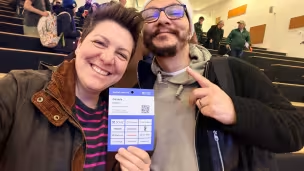
Recently Daniela and I have attended the Scottish Web Folk conference with our colleagues from WAC. The theme was “Human vs Machine”. There we saw some enlightening talks that addressed not only the state and the progress of AI in web development and content creation, but also the human side of organisations that are trying to keep up with all these advancements.